Hydrometallurgy vs Pyrometallurgy in Modern Refining: Energy, Emissions, Recovery—and The Big Questions You Need To Be Asking

Two Worlds of Refining:
If you strip away the jargon, most modern metal refining routes fall into two families, hydrometallurgy vs pyrometallurgy:
- Pyrometallurgy: High heat to melt, smelt, or volatilize components.High temperatures effectively eliminate materials like polymers that break down at lower temperatures. The oxides of less reactive elements like iron, copper, zinc, chromium, tin, and manganese are commonly extracted through pyrometallurgical processes.
- Hydrometallurgy: Aqueous chemistry to dissolve and separate metals through controlled reactions. It involves dissolving metals (leaching) with acids or bases, purifying the mixture by ion exchange or solvent extraction, and recovering the metal by electrowinning or precipitation. It is ideal for low-grade ores that contain metals like zinc, copper, gold, and silver.
Both are industrially valid. The real question is which approach makes sense for a given feedstock, purity target, infrastructure, and compliance environment.

Pyrometallurgy: The Classic Powerhouse
Pyrometallurgy is powerful because it can handle complex, contaminated feedstocks and can process large throughputs. But it typically relies on high temperature operations—often meaning higher energy demand and more involved controls for off-gases and emissions.
Pyrometallurgical techniques are currently being used in a majority of industrial facilities, where used LIBs are places directly into a furnace and melted at high temperatures (500°C-1000°C). The plastic, electrolyte, and carbonaceous components in LIBs are destroyed in the process, and valuable metals like Co, Ni, Mn, Cu, and many others are collected from the melted metals and alloys.
Pyrometallurgy followed by nitric acid leaching provides an affective, environmentally conscious route to extract metals like copper and gold. HNO oxidizes sulfides after their thermal pretreatment, offering recoveries of up to 97.9% compared to sulphuric acid.
A peer-reviewed comparison in the platinum group metals (PGM) context examined energy consumption differences between hydrometallurgical metal refining routes and conventional pyrometallurgical smelting/refining.
(Important note: The exact numbers vary by plant design and feedstock, but this paper is a good example of why energy is a core differentiator.)
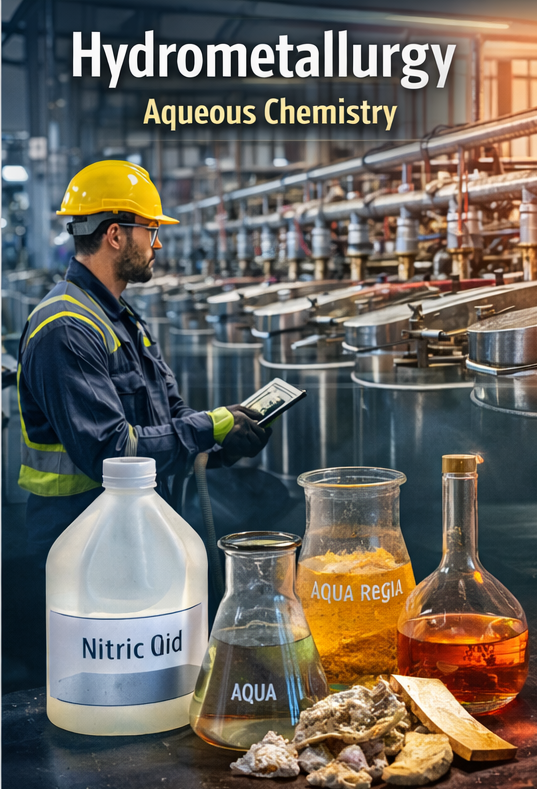
Hydrometallurgy: Precision Chemistry—With Its Own Responsibilities
Hydrometallurgy is often favored when:
- Selective recovery matters, especially for low-grade ores like gold, copper, zinc, and nickel.
- Lower-temperature operations are desired because it utilizes water and acid-based solutions.
- The downstream product must meet tight purity specs, ensuring the production of high-purity metals and compounds.
In battery and e-waste contexts, hydrometallurgy is frequently discussed as a route that can provide high recovery and strong selectivity, while requiring careful management of chemical hazards and waste streams.
Hydrochloric acid (HCl) is used in hydrometallurgy due to it’s high-efficiency leaching process. Hydrochloric acid is used to dissolve a variety of metals from raw ores, electronic waste, and scrap. HCl is preferred over sulfuric acid in many cases for its faster reaction rates, easier acid regeneration via pyrohydrolysis, and ability to dissolve iron oxides.
The “Real-life” Comparison: What changes for customers?
If you’re a manufacturer, recycler, or industrial generator choosing a refiner, the question isn’t “hydro vs pyro” as a debate. It’s:
1) What’s my feedstock—and how variable is it?
- Mixed streams (e-waste, shredded materials) can benefit from robust front-end sorting and flexible processing.
- Concentrates or known alloys may benefit from more targeted approaches.
2) What’s the purity target—and who buys the output?
Battery-grade and catalyst-grade products impose strict impurity limits. Hydrometallurgy can be advantageous when you need higher selectivity and refined separation steps.
3) What is the compliance footprint?
Both approaches carry compliance responsibilities:
- Pyro: Combustion/off-gas controls, particulate, metals emissions management
- Hydro: Chemical storage, wastewater/effluent treatment, hazardous residues management
This is where professional operations differentiate themselves: not by claiming “green,” but by demonstrating documented control.
A Practical Framework: The Questions Buyers Should Ask
Before you choose a partner for hydrometallurgy or pyrometallurgy metal refining, you need to be asking these essential questions:
- Do you operate a formal EHS management system?
- How do you control and document downstream waste/residue management?
- Do you use certified downstream partners (e.g., R2/e-Stewards for electronics streams)?
- What analytical methods do you use to verify recovery and purity?
- Can you provide COA/COC, batch traceability, and process documentation?
You need a disciplined, compliance-forward operator with all of the complete documentation to assure your operations move forward smoothly.
Where The Industry Is Headed:
The metal refining industry is fast moving all the time, and it won’t always be hydrometallurgy vs pyrometallurgy, but how these processes are carried out with intentional understanding of the impacts on our environment and long-term sustainability. The trendline in many segments is toward:
- Better preprocessing (to reduce contamination early)
- More selective recovery
- Stronger QA and traceability
- Standards-driven downstream control
The IEA’s critical minerals recycling analysis frames recycling scale-up as strategic for security and sustainability—pushing the market toward more rigorous systems and broader adoption. With companies like Alchemie Labs lining up in the forefront of the market, the modern metal refining industry is looking at longevity and success in the growing years.
Choose a Reliable Partner for the Future of Refining:
At Alchemie Labs, we don’t just complete the bare minimum, we strive for the best, always putting our partners, quality of materials, and the environment first. Whether hydrometallurgy or pyrometallurgy is the best process for your operations, Alchemie Labs produces the highest quality reagent-grade acids to optimize your efficiency, output, and sustainable metal recovery.
As you’re shifting with the ever-growing refining industry, you need a partner that can keep up. Contact us today to take the next steps in reshaping the future of metal refining together.
Sources
- Energy consumption comparison paper (PGM): Kell hydrometallurgical vs conventional pyrometallurgical refining
- LIB recycling process review (PMC)
- 2025 overview/analysis on LIB recycling methods + hydro tradeoffs
- LCA/comparative impacts across recycling technologies (ScienceDirect, 2025)
- IEA critical minerals recycling report context
- EPA guidance pointing to R2/e-Stewards as signals of responsible electronics recycling
- Pyrometallurgy: An Overview
- Hydrometallurgy Wikipedia
- Hydrochloric Acid in Hydrometallurgy